


A brilliant business idea or a premium service means very little if your target audience cannot find you online. In today’s hyper-competitive digital landscape, an effective marketing strategy cannot exist in a vacuum—it must be structurally intertwined with Search Engine Optimization (SEO).
When you construct a marketing plan that considers search algorithms from day one, you stop chasing temporary visibility. Instead, you build a permanent digital asset that generates organic, high-converting leads around the clock.
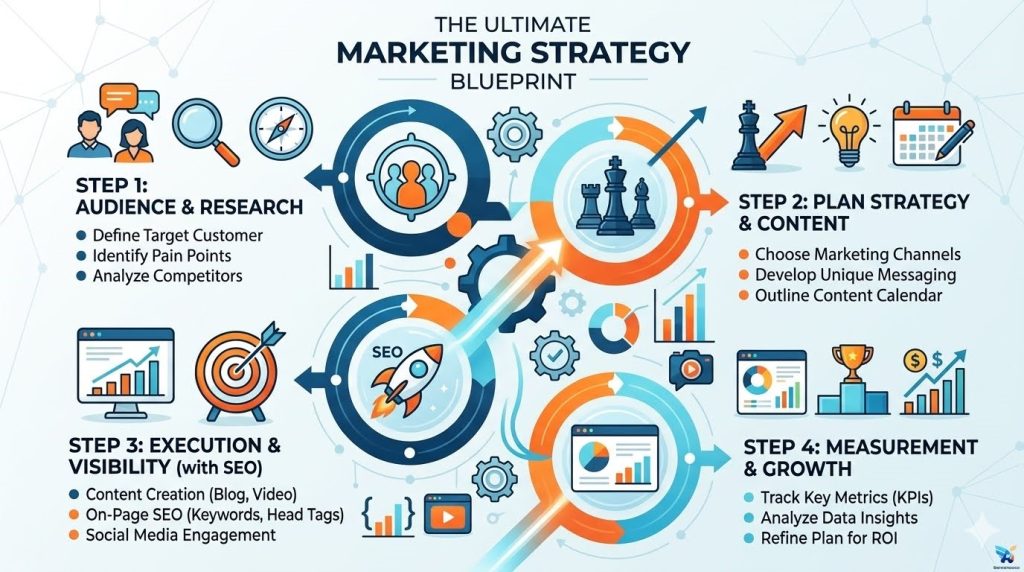
Here is your step-by-step structural blueprint for building a marketing plan that ranks high on Google and converts casual readers into loyal corporate clients.
1. Align Your Marketing Plan with Search Intent
Before designing assets or writing copy, an effective marketing strategy requires deep audience research. In SEO, this means understanding Search Intent—the underlying reason why a user types a specific phrase into Google.
To capture qualified traffic, your marketing content plan should target three distinct stages of the customer journey:
- Informational Intent (Awareness Stage): Users looking for answers or guides (e.g., “how to grow a business online”). Address these through educational, high-value blog posts.
- Commercial Intent (Consideration Stage): Users actively comparing their options (e.g., “best branding agencies for startups”). Target these with in-depth corporate case studies, whitepapers, and portfolio layouts.
- Transactional Intent (Conversion Stage): Users ready to buy right now (e.g., “hire corporate website designer”). These keywords must lead directly to your optimized services or packages pages.
2. Create High-Quality Content (The E-E-A-T Framework)
Google explicitly prioritizes content that demonstrates Experience, Expertise, Authoritativeness, and Trustworthiness (E-E-A-T). To ensure your marketing strategy satisfies these guidelines, steer clear of generic, thin content.
Solve Real User Problems
Your plan should focus on creating comprehensive resources that completely answer a user’s question in one place. If a user lands on your website and immediately leaves because your content lacks substance, search engines will mark your page as irrelevant and drop your rankings.
Incorporate Multi-Media Elements
Break up heavy blocks of text by integrating high-quality imagery, infographics, and embedded short-form videos (such as YouTube Shorts). Multimedia keeps users engaged and increases their “time-on-page,” which signals to search engines that your content is highly valuable.
3. Optimize On-Page and Technical SEO Elements
You can write the most inspiring marketing copy in the world, but if search engine crawlers cannot technically read and index your website layout, your visibility will remain flat. Ensure your developer or web team optimizes these critical technical components:
- Header Hierarchy: Ensure your page utilizes exactly one
<h1>tag for the main title, followed by organized, logical subsections using<h2>and<h3>tags. Never skip header levels. - Image Optimization and Alt Text: Large images will slow down your website speed, causing visitors to leave. Always compress your images before uploading. Furthermore, write descriptive Alt Text for every graphic to help visually impaired users and search engine bots understand what the image represents.
- Mobile-First Architecture: Over half of global web traffic originates from mobile devices. Your website layout must load fast, look clean, and scale fluidly across all smartphone screen sizes.
4. Summary: The Modern Marketing Layer
To see how different digital marketing tracks align perfectly with an SEO framework, look at this integrated structure:
| Marketing Layer | Technical SEO Action | Direct Business Result |
|---|---|---|
| Creative Design | Compressed files, clean code, descriptive Alt Text | Faster loading speeds & lower user bounce rates |
| Content Creation | Long-form, highly focused keyword optimization | Consistent, high-volume organic web traffic |
| Video Production | Strategic YouTube descriptions & metadata tagging | Multi-platform authority & cross-channel discovery |
Building an effective marketing strategy is a marathon, not a sprint. By embedding technical parameters and search intent directly into your core business plans, you ensure that your brand’s digital visibility steadily compounds month after month.

Leave a Reply